GMUNK
United States New York
United States, New York
GMUNK (Bradley G. Munkowitz) is a digital artist, director, and motion designer whose practice has explored the evolving relationship between design, technology, light, image, and movement for more than two decades. Working across digital art, motion design, interactive media, film, installations, photography, projection, and data visualisation, he has developed a distinctive visual language characterised by experimentation, technological curiosity, and a continuous movement between physical and digital media.
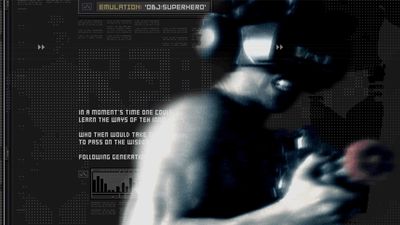
Emerging from the experimental digital culture of the late 1990s and early 2000s, GMUNK was among a generation of artists and designers who approached the web as a new creative medium. His early Flash-based works combined animation, graphic design, sound, code, and interaction to create audiovisual experiences conceived specifically for the screen and the emerging language of online culture. These works became influential within the international digital design community and have been studied in design schools for more than two decades.
As technologies evolved, his practice expanded beyond the browser into increasingly diverse forms of visual experimentation. His work encompasses short films, interactive experiences, installations, live visuals, title sequences, music videos, experimental photography, projection mapping, and large-scale audiovisual productions, often combining digital processes with light, cameras, robotics, and physical environments.
Among his best-known projects is BOX (2013), created with Bot & Dolly, which combined projection mapping, robotics, and performance in a precisely choreographed physical environment. He also led the design of holographic and interface content for TRON: Legacy and contributed to the visual world of Oblivion. In 2015, he created the iconic Windows 10 desktop image, using physical light, projection, lasers, and photographic techniques rather than a purely computer-generated approach.
GMUNK’s work has been exhibited and sold internationally, including at Christie’s and Sotheby’s, while his artistic and commissioned projects have reached audiences far beyond traditional exhibition contexts. Throughout his career, he has continued to move between art, design, technology, and popular culture, applying the experimental approach of his earliest digital work to continually changing media and technological environments.
Emerging from the experimental digital culture of the late 1990s and early 2000s, GMUNK was among a generation of artists and designers who approached the web as a new creative medium. His early Flash-based works combined animation, graphic design, sound, code, and interaction to create audiovisual experiences conceived specifically for the screen and the emerging language of online culture. These works became influential within the international digital design community and have been studied in design schools for more than two decades.
As technologies evolved, his practice expanded beyond the browser into increasingly diverse forms of visual experimentation. His work encompasses short films, interactive experiences, installations, live visuals, title sequences, music videos, experimental photography, projection mapping, and large-scale audiovisual productions, often combining digital processes with light, cameras, robotics, and physical environments.
Among his best-known projects is BOX (2013), created with Bot & Dolly, which combined projection mapping, robotics, and performance in a precisely choreographed physical environment. He also led the design of holographic and interface content for TRON: Legacy and contributed to the visual world of Oblivion. In 2015, he created the iconic Windows 10 desktop image, using physical light, projection, lasers, and photographic techniques rather than a purely computer-generated approach.
GMUNK’s work has been exhibited and sold internationally, including at Christie’s and Sotheby’s, while his artistic and commissioned projects have reached audiences far beyond traditional exhibition contexts. Throughout his career, he has continued to move between art, design, technology, and popular culture, applying the experimental approach of his earliest digital work to continually changing media and technological environments.
LINKS
SOCIAL
Program
Saturday, 09 September 2006