
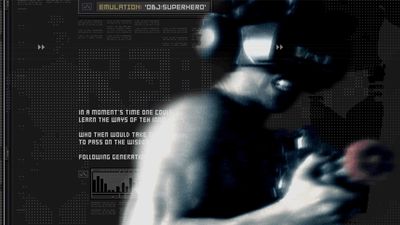
DMGI.O
Net Art
Duration: 30 min.
Tuesday, 23 May 2006 | 15:00 > 15:002006-05-23T15:00:00.000Z
Year: 2001
Medium: Macromedia Shockwave Flash
DMGI.O belongs to a generation of interactive digital works that emerged in the early 2000s, when the web was becoming a space for experimentation with new forms of visual language, interaction, and non-linear storytelling. Created in Flash, the work approaches the screen not as a surface for displaying content, but as an environment to be explored.
There is no immediately visible path through DMGI.O. The viewer must enter its visual and sonic atmosphere, observe, experiment, and gradually discover where and how interaction is possible. Interfaces are not necessarily declared as such, and progression requires attention, curiosity, and patience. An action may reveal a new sequence or open different possibilities, turning navigation itself into an essential part of the experience.
Rather than following a predetermined narrative, the work unfolds through multiple possible trajectories. Each choice can lead towards different visual environments and subsequent interactions, creating a labyrinth of potential narratives generated through the relationship between the user and the work. The experience is therefore not simply viewed: it is constructed through exploration, discovery, hesitation, repetition, and choice.
This approach was characteristic of an extraordinary period of experimentation on the early web, when artists and designers used technologies such as Flash to question what an interface, a website, or a digital narrative could be. Interaction did not necessarily aim for immediacy or efficiency; complexity and disorientation could themselves become creative materials.
More than two decades later, DMGI.O also reveals the distance between that experimental conception of the web and the increasingly standardised forms of interaction that characterise much of today's online experience. Re-presented in its interactive form, the work restores access not only to a digital artwork from another technological era, but to a moment when entering a website could mean entering an unknown space, learning its rules through experience, and discovering a narrative that existed only through interaction.
Medium: Macromedia Shockwave Flash
DMGI.O belongs to a generation of interactive digital works that emerged in the early 2000s, when the web was becoming a space for experimentation with new forms of visual language, interaction, and non-linear storytelling. Created in Flash, the work approaches the screen not as a surface for displaying content, but as an environment to be explored.
There is no immediately visible path through DMGI.O. The viewer must enter its visual and sonic atmosphere, observe, experiment, and gradually discover where and how interaction is possible. Interfaces are not necessarily declared as such, and progression requires attention, curiosity, and patience. An action may reveal a new sequence or open different possibilities, turning navigation itself into an essential part of the experience.
Rather than following a predetermined narrative, the work unfolds through multiple possible trajectories. Each choice can lead towards different visual environments and subsequent interactions, creating a labyrinth of potential narratives generated through the relationship between the user and the work. The experience is therefore not simply viewed: it is constructed through exploration, discovery, hesitation, repetition, and choice.
This approach was characteristic of an extraordinary period of experimentation on the early web, when artists and designers used technologies such as Flash to question what an interface, a website, or a digital narrative could be. Interaction did not necessarily aim for immediacy or efficiency; complexity and disorientation could themselves become creative materials.
More than two decades later, DMGI.O also reveals the distance between that experimental conception of the web and the increasingly standardised forms of interaction that characterise much of today's online experience. Re-presented in its interactive form, the work restores access not only to a digital artwork from another technological era, but to a moment when entering a website could mean entering an unknown space, learning its rules through experience, and discovering a narrative that existed only through interaction.
Author
 GMUNK (Bradley G. Munkowitz) is a digital artist, director, and motion designer whose practice has explored the evolving relationship between design, technology, light, image, and movement for more than two decades. Working across digital art, motion design, interactive media, film, installations, photography, projection, and data visualisation, he has developed a distinctive visual language characterised by experimentation, technological curiosity, and a continuous movement between physical and digital media.
Emerging from the experimental digital culture of the late 1990s and early 2000s, GMUNK...